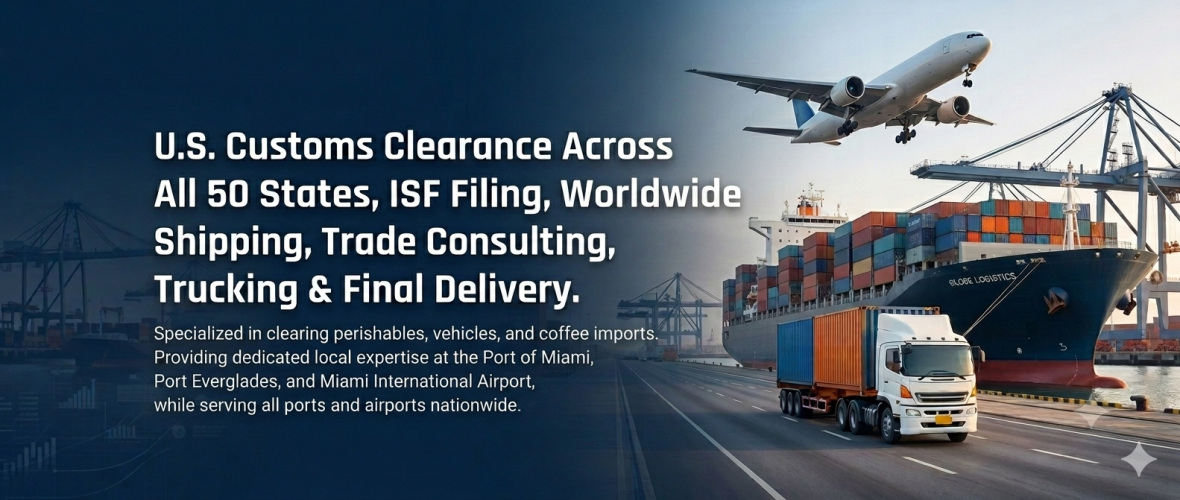
A Miami perishables customs broker clears fresh produce, seafood, cut flowers, wine/spirits, and specialty foods through Miami International Airport (MIA), PortMiami, and Port Everglades by coordinating U.S. Customs and Border Protection (CBP) entry with mandatory Partner Government Agency (PGA) filings—including FDA Prior Notice, USDA-APHIS inspections, FSVP verification, and TTB alcohol approvals—before cargo arrives. Because perishable and food shipments face strict statutory deadlines and cold-chain spoilage risks, advance electronic filing through the Automated Commercial Environment (ACE) is essential to prevent port holds, refusals, and demurrage.

Why Miami Is the U.S. Perishables & Specialty Food Gateway
South Florida operates as the primary U.S. cold-chain hub for Latin American, Caribbean, and European food and agricultural trade:
- Miami International Airport (MIA): MIA is the leading U.S. airport for international freight and handles roughly 91% of all U.S. air-imported cut flowers (~394,000 tons), over half of U.S. air-imported seafood, and major volumes of fresh fruits and vegetables.
- PortMiami & Port Everglades: Fruits and vegetables represent PortMiami’s #1 containerized import commodity by volume, alongside steady refrigerated container arrivals of frozen seafood, coffee, specialty groceries, wine, and spirits across both PortMiami and Port Everglades.
- Cold-Chain & Inspection Speed: Inspectors at MIA and PortMiami process perishable cargo every day. While local facilities have built-in cold storage and exam infrastructure, incomplete documents or late agency filings trigger immediate holds.
Regulatory Requirements by Commodity Category
Different food, floral, and beverage imports trigger different federal agencies inside CBP’s ACE system. Your customs broker must transmit the right PGA data sets alongside your CBP entry:
| Commodity Niche | Primary Miami Gateway | Key Agencies Involved | Critical Pre-Arrival Requirements |
| Fresh Produce & Fruits | MIA (air) & PortMiami (reefer ocean) | CBP, FDA, USDA-APHIS | FDA Prior Notice, USDA phytosanitary certificate (where required), pest inspection, FSVP importer data |
| Fresh & Frozen Seafood | MIA (air) & PortMiami / Port Everglades | CBP, FDA, NOAA Fisheries (NMFS) | FDA Prior Notice, Seafood HACCP / FSVP, SIMP (Seafood Import Monitoring Program) catch/harvest data for covered species |
| Cut Flowers & Live Plants | MIA (air cargo) | CBP, USDA-APHIS-PPQ | Mandatory port-of-entry inspection (7 CFR 319.74-2); phytosanitary certificate for restricted/host genera (such as chrysanthemum white rust hosts) |
| Wine, Beer & Spirits | PortMiami & Port Everglades | CBP, TTB, FDA | TTB Importer’s Basic Permit, COLA (Certificate of Label Approval), FDA Food Facility Registration, FDA Prior Notice, federal excise tax calculation |
| Ethnic Groceries, Coffee & Packaged Foods | PortMiami, Port Everglades & MIA | CBP, FDA, USDA (if meat/dairy/egg ingredients) | FDA Food Facility Registration, FDA Prior Notice, FSVP compliance, ingredient/allergen labeling review, USDA-FSIS permits if animal products apply |
Deadlines Every Perishable & Food Importer Must Hit
Missing a single filing clock can stop a perishable shipment even if your standard customs entry is ready:
1. FDA Prior Notice Deadlines (21 CFR 1.279)
Under FDA Prior Notice rules, advance electronic notice must be submitted and confirmed by the FDA (with a Prior Notice confirmation number) before the food arrives at the U.S. port of entry:
- By Air (MIA): At least 4 hours before aircraft arrival.
- By Ocean Vessel (PortMiami / Port Everglades): At least 8 hours before vessel arrival.
- By Road / Rail: At least 2 hours before arrival by road, or 4 hours before arrival by rail.
2. Ocean ISF 10+2 Filing (19 CFR Part 149)
For ocean containers arriving at PortMiami or Port Everglades—including refrigerated (reefer) containers of produce, frozen seafood, wine, or dry groceries—eight importer elements of the Importer Security Filing (ISF 10+2) must be transmitted at least 24 hours before vessel loading at the foreign port, with stuffing location and consolidator filed no later than 24 hours before U.S. arrival. Review our complete ISF 10+2 customs filing guide for Miami importers for full element-by-element rules.
3. Pre-Arrival Air Cargo & Weekend Release Coordination
Widebody cargo flights from Colombia, Peru, Chile, Ecuador, Costa Rica, and Europe arrive at MIA around the clock. Experienced brokers prepare air entries prior to wheels-down so CBP and USDA/FDA releases post immediately upon flight arrival, allowing refrigerated trucks to recover freight before airport storage fees accrue.
5 Common Mistakes That Delay Perishable & Food Imports in Miami
- Unregistered Foreign Food Facilities: Under the Bioterrorism Act and FSMA rules, foreign manufacturers, processors, packers, or holders of human or animal food must maintain an active FDA Food Facility Registration (renewed biennially in even-numbered years) with a valid Unique Facility Identifier (UFI/DUNS). If the foreign supplier’s registration is expired or canceled, FDA Prior Notice will reject or hold the shipment.
- Missing FSVP Importer Information: Under the Foreign Supplier Verification Program (FSVP), the U.S. importer must verify that foreign suppliers meet U.S. food safety standards and provide the FSVP importer’s name, email, and UFI on every FDA food entry.
- Assuming Every Cut Flower Needs—or Doesn’t Need—a Phytosanitary Certificate: Under 7 CFR 319.74-2, all commercial cut flowers are subject to USDA inspection at the first U.S. port of arrival, while phytosanitary certificates are required specifically for genera/origins regulated for pests such as chrysanthemum white rust. Confirming genus and origin before packing prevents unnecessary origin delays or port destruction orders.
- Shipping Alcohol Without a TTB COLA: Importing commercial wine, beer, or spirits without a TTB Importer’s Basic Permit and an approved Certificate of Label Approval (COLA) (or valid COLA waiver) results in immediate CBP/TTB detention at PortMiami or Port Everglades.
- Multi-SKU Invoices With Unmapped FDA Product Codes: Specialty grocery and gourmet food containers often carry 20 to 50 distinct SKUs. Each food line item requires its own accurate HTSUS classification and 7-character FDA Product Code. Sending spreadsheets with HTS codes, ingredient descriptions, and supplier registration numbers at least 48 hours before arrival avoids last-minute entry bottlenecks.
Coordinating Customs Clearance With Cold-Chain Drayage
Once CBP, FDA, and USDA issue electronic releases, ocean containers at PortMiami and Port Everglades must move quickly off the terminal before free time expires. Working with a team that coordinates both Miami perishable customs clearance and South Florida container drayage ensures your reefer container is dispatched to cold storage or your distribution warehouse immediately upon release—or routed cleanly if CBP/USDA orders a Centralized Examination Station (CES) or agriculture inspection.
Frequently Asked Questions About Perishable & Food Customs Clearance in Miami
Under 21 CFR 1.279, FDA Prior Notice must be submitted and confirmed by the FDA at least 4 hours before arrival by air (such as at Miami International Airport) and at least 8 hours before arrival by ocean vessel (such as at PortMiami or Port Everglades). Filing through ACE alongside the customs entry helps ensure the Prior Notice confirmation number is issued well ahead of arrival.
No. Under 7 CFR 319.74-2, all imported cut flowers undergo USDA-APHIS inspection upon arrival at MIA, but phytosanitary certificates are required only for specific flower genera and origins regulated for plant pests such as chrysanthemum white rust. Checking the botanical genus and country of origin with your customs broker before departure avoids unexpected holds.
Commercial alcohol importers must hold a federal TTB Importer’s Basic Permit, provide an approved TTB Certificate of Label Approval (COLA) for each label, verify that the foreign producer has an active FDA Food Facility Registration, and file FDA Prior Notice prior to vessel arrival. Your customs broker also calculates applicable CBP duties, federal excise taxes, and Harbor Maintenance/Merchandise Processing fees.
Many delays on food, produce, seafood, and floral shipments are Partner Government Agency (PGA) holds issued by the FDA or USDA-APHIS rather than CBP duty issues. Common triggers include an unconfirmed FDA Prior Notice, an expired foreign FDA facility registration, missing FSVP importer data, missing SIMP seafood harvest records, or random USDA agricultural pest inspections.
Yes. A licensed U.S. customs broker files your ISF 10+2 at least 24 hours before foreign vessel loading and then transmits your CBP entry, FDA Prior Notice, FSVP data, and USDA-APHIS declarations in ACE prior to arrival at PortMiami or Port Everglades.