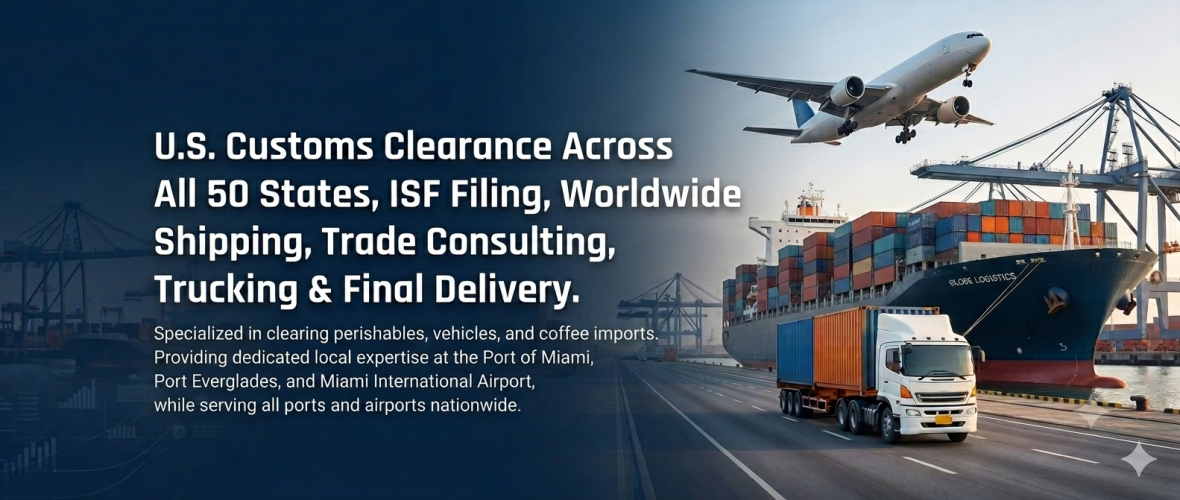

Miami Customs Brokers: Fast & Reliable ISF Filing Services
Streamline Your Import Process with Ease
- Classify 2. Submit ISF. 3. File Customs Entry. 4. Approval 5. Pickup 6. Complete

Navigating international trade requires speed, precision, and absolute regulatory compliance. As premier Miami Customs Brokers, we specialize in providing fast, accurate Importer Security Filing (ISF)—commonly known as 10+2 filing—to keep your supply chain moving smoothly without costly interruptions.
Whether your ocean container is heading to the bustling Port of Miami, arriving at Port Everglades, or you are managing high-priority air cargo landing at Miami International Airport, our experienced brokerage team coordinates seamlessly with U.S. Customs and Border Protection (CBP) to protect your bottom line.
Why Timing is Critical: The $5,000 ISF Penalty Rule
By federal law, your ISF submission must be electronically transmitted and accepted by CBP at least 24 hours before your cargo is loaded onto the vessel at the foreign port of departure.
Failing to meet this window or submitting inaccurate data results in severe consequences:
- An automatic, non-negotiable $5,000 liquidated damages penalty per violation from CBP.
- Immediate cargo holds and customs examinations upon arrival.
- Accumulating port storage, demurrage, and unexpected drayage fees.
As your dedicated Miami Customs Brokers, we eliminate this risk by proactively auditing your commercial invoices, packing lists, and bills of lading to transmit clean, compliant files long before the deadline hits.
Strategic East Coast Customs Clearance
While we operate locally in South Florida, our direct electronic data interchange (EDI) framework allows us to provide comprehensive East Coast Customs Clearance across all major U.S. ports of entry. We frequently manage integrated supply chains moving through major logistical gateways, including high-volume consumer and industrial freight lanes moving into New York and New Jersey.
By consolidating your national customs entries under a single point of contact, you ensure consistent HTS classification, unified billing, and predictable clearance times—whether your freight touches down in Florida, New York, or New Jersey.
The 10+2 ISF Requirements Breakdown
To successfully file an ocean import ISF, we require 10 critical data elements from the importer or supplier, paired with 2 carrier status messages from the ocean line:
- Seller Name & Address
- Buyer Name & Address
- Importer of Record Number
- Consignee Number(s)
- Manufacturer (or Supplier) Name & Address
- Ship-to Party Name & Address
- Country of Origin
- Harmonized Tariff Schedule (HTSUS) Number
- Container Stuffing Location
- Consolidator (Stuffer) Name & Address
Frequently Asked Questions About ISF (10+2) Filing in Miami
1. What is an ISF (Importer Security Filing) and when must it be submitted?
- Answer: An Importer Security Filing (commonly known as the “10+2” rule) is a mandatory U.S. Customs and Border Protection (CBP) regulation for ocean cargo arriving in the United States. It must be submitted electronically at least 24 hours before the cargo is laden aboard the vessel at the foreign port of origin to avoid severe penalties.
2. What are the penalties or liquidated damages for a late or inaccurate ISF filing?
- Answer: Failing to file on time, or submitting inaccurate data, can trigger immediate CBP enforcement action, including liquidated damages starting at $5,000 per violation, non-intrusive container scans, or severe port delays that result in costly demurrage and detention charges.
3. What information is required to complete a 10+2 ISF filing?
- Answer: An ISF requires 10 data elements from the importer and 2 elements from the ocean carrier. Key data points include the Manufacturer/Supplier name and address, Buyer name and address, Ship-to party, Country of origin, and the 6-digit Harmonized Tariff Schedule (HTS) number.
4. Can an ISF be filed for cargo arriving at PortMiami or Port Everglades if it is moving onward?
- Answer: Yes. Whether your ocean container is clearing directly at South Florida ports like PortMiami or Port Everglades or moving via Immediate Export (IE) or Transportation and Exportation (T&E) bond to another state, a proper ISF must still be executed before vessel departure.
5. How does a customs broker handle changes or amendments to an already submitted ISF?
- Answer: Supply chain details frequently shift before a vessel departs. If container numbers, vessel voyages, or bill of lading details change, an experienced customs broker immediately transmits electronic amendments to CBP to maintain compliance and prevent automatic tracking holds.
6. Why should I use a specialized Miami broker for my ISF filings instead of my overseas supplier?
- Answer: Relying on overseas suppliers or forwarders often leads to communication gaps, time-zone delays, and missed 24-hour windows. Partnering with a dedicated local U.S. customs broker ensures direct accountability, rapid compliance checks, and protection against costly penalty notices.
Clear Your Cargo Fast with Expert Miami Customs Brokers
Don’t leave your cargo’s entry to chance or risk devastating border delays. Our team handles your automated filings, secures the necessary single or continuous customs bonds, and guides you step-by-step through the process.
Get a Free ISF Filing & Miami Customs Clearance Quote Today!