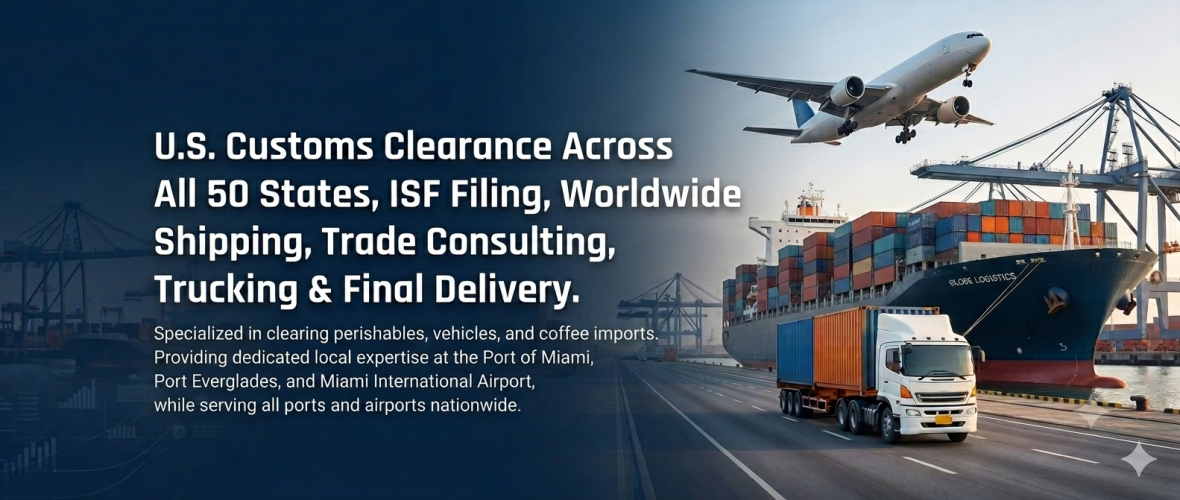
Green Coffee Custom Clearance & Import Brokerage Miami

Key Takeaways
- The FDA, USDA, and CBP are the three primary agencies that regulate green coffee bean imports.
- Green coffee beans cannot enter through Hawaii or Puerto Rico due to pest concerns.
- Most HTS codes for coffee fall under the 0901 heading and are duty-free.
- Top sourcing countries include Brazil, Colombia, Vietnam, and Guatemala.

Streamlining FDA, USDA, and CBP Compliance for Green and Roasted Coffee Importers
Are you importing green coffee beans or roasted coffee into the United States through PortMiami or Miami International Airport? Navigating the overlapping regulations of U.S. Customs, the FDA, and the USDA can be challenging. A single missing document or delayed filing can result in costly storage fees, border rejections, or spoiled cargo. As specialized Miami customs brokers, we manage your entire coffee supply chain entry so your shipment clears quickly and arrives safely.
Essential Compliance Requirements for Importing Green Coffee
Importing green (unroasted) coffee beans into international markets—specifically the United States—requires strict adherence to agricultural and food safety laws. To successfully clear your cargo through U.S. Customs and Border Protection (CBP), you must meet three foundational compliance pillars:
1. FDA Food Facility Registration
Before any food or beverage enters the U.S., the foreign facility that grows, processes, or packs the coffee beans must be registered with the U.S. Food and Drug Administration (FDA). Additionally, the domestic importer must have a registered U.S. agent.
2. FDA Prior Notice Filing
The FDA must be notified of your coffee shipment before it physically arrives at a U.S. port of entry. The timeline for filing Prior Notice depends strictly on your shipping method:
- By Air: No less than 4 hours before arrival.
- By Sea: No less than 8 hours before arrival.
- By Land (Rail/Truck): 2 to 4 hours before arrival.
Failure to file Prior Notice on time results in an automatic refusal of entry at the Miami port.
3. USDA APHIS Agricultural Inspections
Because green coffee beans can harbor agricultural pests—such as the highly destructive Coffee Berry Borer or coffee rust fungus—they are subject to mandatory inspection by the USDA Animal and Plant Health Inspection Service (APHIS).
- Pest-Free Certification: Shipments must be free of soil, pests, and debris.
- Fumigation Requirements: If live insects are detected during a routine Miami port inspection, your container will be ordered into immediate quarantine for mandatory chemical fumigation at the importer’s expense.
HTS Codes & Duty Rates for Coffee Imports
While most green and roasted coffee enters the United States duty-free, you must still classify your shipment with the correct HTS code to avoid misdeclaration penalties from CBP.
- Green Coffee Beans (Not Decaffeinated) | HTS Code:
0901.11.00| U.S. Import Duty Rate: Free (0%) - Green Coffee Beans (Decaffeinated) | HTS Code:
0901.12.00| U.S. Import Duty Rate: Free (0%) - Roasted Coffee Beans (Not Decaffeinated) | HTS Code:
0901.21.00| U.S. Import Duty Rate: Free (0%) - Roasted Coffee Beans (Decaffeinated) | HTS Code:
0901.22.00| U.S. Import Duty Rate: Free (0%) - Coffee Husks and Skins | HTS Code:
0901.90.10| U.S. Import Duty Rate: Free (0%)
⚠️ Is Your Coffee Shipment Already En Route to Miami?
Do not risk customs holds, costly demurrage penalties, or USDA quarantine delays. Our experienced Miami-based customs brokerage team is ready to review your paperwork, file your FDA Prior Notice, and secure your Single or Continuous Customs Bond today.
👉 Get a quote at MiamiCustomsClearance.com

Frequently Asked Questions About Importing Coffee into Miami
1. What compliance requirements apply when importing green coffee?
- Answer: Importing green coffee into the U.S. requires compliance with FDA Prior Notice regulations and USDA/APHIS phytosanitary documentation standards to verify origin and safety.
2. How is green coffee cleared through Miami ports?
- Answer: Green coffee arriving via PortMiami or MIA must clear customs by submitting electronic entries, clearing FDA/USDA holds promptly, and arranging seamless port drayage or warehouse delivery.
3. What documents are required for customs clearance on commercial coffee shipments?
- Answer: To clear U.S. Customs and Border Protection (CBP) successfully, your coffee shipment must be accompanied by a commercial invoice, packing list, bill of lading (BOL), and an arrival notice. For ocean shipments arriving at South Florida ports, a 10+2 Importer Security Filing (ISF) must also be submitted at least 24 hours prior to vessel departure.
4. Are green coffee beans subject to customs duties or tariffs in the U.S.?
- Answer: Whole green coffee beans classified under standard HTS codes are generally duty-free. However, commercial importers must still account for standard processing fees, including the Merchandise Processing Fee (MPF) and the Harbor Maintenance Fee (HMF) for ocean freight, which your licensed customs broker calculates during entry filing.
5. Why should I use a local Miami customs broker for coffee logistics?
- Answer: Partnering with a local customs broker in Miami gives you direct oversight at key logistics hubs like PortMiami, Port Everglades, and Miami International Airport (MIA). Local expertise ensures rapid coordination during multi-agency holds (CBP, FDA, or USDA), minimizing port storage fees and preventing costly supply chain bottlenecks.
6. How does a customs broker handle detained or held green coffee shipments?
- Answer: If the FDA or USDA places a hold or exam on your coffee shipment due to documentation errors or agricultural reviews, an experienced customs broker immediately communicates with inspectors, submits required compliance paperwork, and coordinates professional sampling or fumigation if pests are suspected, getting your cargo released as quickly as possible.
Required Documents for Green Coffee Clearance:
- Commercial Invoice & Packing List: Detailing exact bean weights, origin, and grade.
- Bill of Lading (BOL): Master or house bill covering the container or air shipment.
- FDA Prior Notice Confirmation: Submitted prior to arrival at PortMiami or Miami International Airport (MIA).
- USDA/APHIS Permits & Phytosanitary Certificates: Mandatory for ensuring compliance with pest and agricultural safety rules.