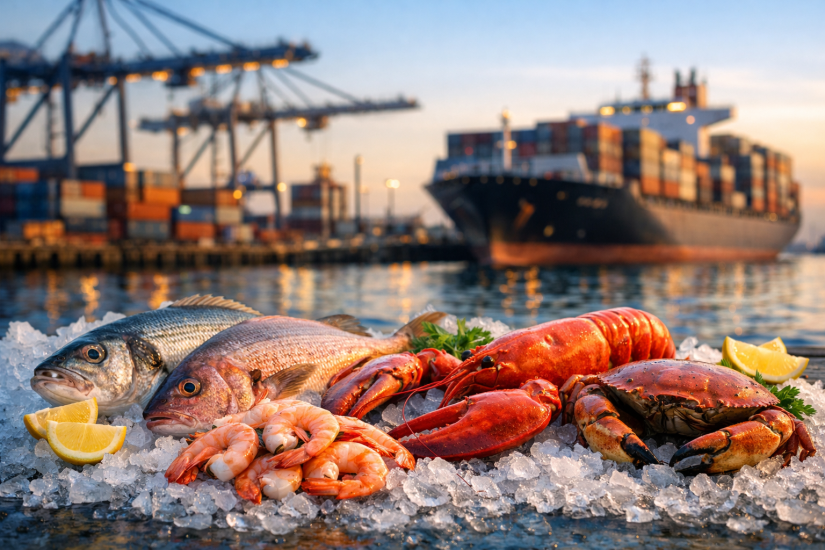
Importing seafood into the United States involves four federal agencies, each with their own requirements. Here’s what you need to know before your first shipment arrives.
The Four Agencies You’ll Deal With
1. FDA
The FDA requires three things from seafood importers:
- Facility Registration — Any facility that manufactures, processes, or holds food for US consumers must register through the FDA Industry System (FIS).
- Prior Notice — You must notify the FDA before each shipment arrives, including product type, quantity, and shipper details. File through ACE or the FDA’s Prior Notice System Interface (PNSI).
- HACCP Plan — You’re required to have a documented food safety plan that identifies hazards, establishes control points, and includes corrective actions and record-keeping.
2. NMFS (National Marine Fisheries Service)
The NMFS regulates seafood through its Seafood Import Monitoring Program (SIMP), covering 13 species groups including shrimp, tuna, cod, grouper, crab, and swordfish.
You’ll need to provide details on the harvesting vessel, the catch (species, date, location, weight), and your International Fisheries Trade Permit (IFTP) number. As of January 1, 2026, imports must also comply with US bycatch regulations under the Marine Mammal Protection Act — foreign fisheries that don’t meet US standards lose access to the market. Some shipments may also require a Certification of Admissibility filed through CBP’s ACE portal.
3. FWS (Fish & Wildlife Service)
File a Declaration Form 3-177 online via the eDecs website. Shipments must enter through a Designated FWS Port — if yours doesn’t qualify, apply for a Designated Port Exception Permit (DPEP). Since seafood is perishable, you may qualify under the cargo deterioration exemption. The permit costs $100 to obtain or renew.
4. CBP (Customs & Border Protection)
- Seafood from Russia is banned under a 2023 Executive Order. Submit a self-certification on company letterhead through CBP’s ACE portal.
- Shrimp imports require a DS-2031 form.
- Every entry needs a commercial invoice with your FDA registration number, species scientific name, and product description (fresh/frozen, whole/fillet).
How To Speed Up Release
Seafood is perishable — delays are costly. Two ways to move faster:
- CBP Form 3461 — Requests expedited release, filed electronically through ACE.
- FDA VQIP — A voluntary program that fast-tracks FDA review for importers with a strong compliance history. Requires at least 3 years of import experience, HACCP compliance, and an annual user fee paid before October 1st.
Where You Can’t Source Seafood From
- Russia — All Russian seafood is prohibited.
- Vaquita Refuge (Mexico) — Seafood from Mexican fisheries operating in this protected area of the Upper Gulf of California is restricted, including shrimp, anchovy, mackerel, and others. The Zero Tolerance Area within the refuge is a complete no-go.
Top Seafood Exporting Countries
| Country / Region | Export Value (2020) |
|---|---|
| European Union | $36.2 billion |
| China | $20.8 billion |
| Norway | $11.9 billion |
| Vietnam | $8.1 billion |
| Chile | $6.7 billion |
The US has strong trade relationships with all five. The EU exports large volumes of salmon, crustaceans, and molluscs. China is a major supplier of tilapia. Norway is known for trout and snow crab. Vietnam’s seafood exports have been growing rapidly, and Chile is one of the top sources of seafood for American buyers.
Need Help Clearing Seafood Through Miami? We can help!
Seafood imports are time-sensitive — and the paperwork is unforgiving. Miami Customs Clearance specializes in exactly this. With over 25 years of experience, their team handles FDA and NOAA compliance, HACCP documentation, inspection coordination, and cold-chain logistics to make sure your fresh or frozen seafood clears customs quickly and reaches the market at peak quality.
From port to final destination, they manage the full process—so you don’t have to.
 Miami Customs Clearance | Customs Broker Miami